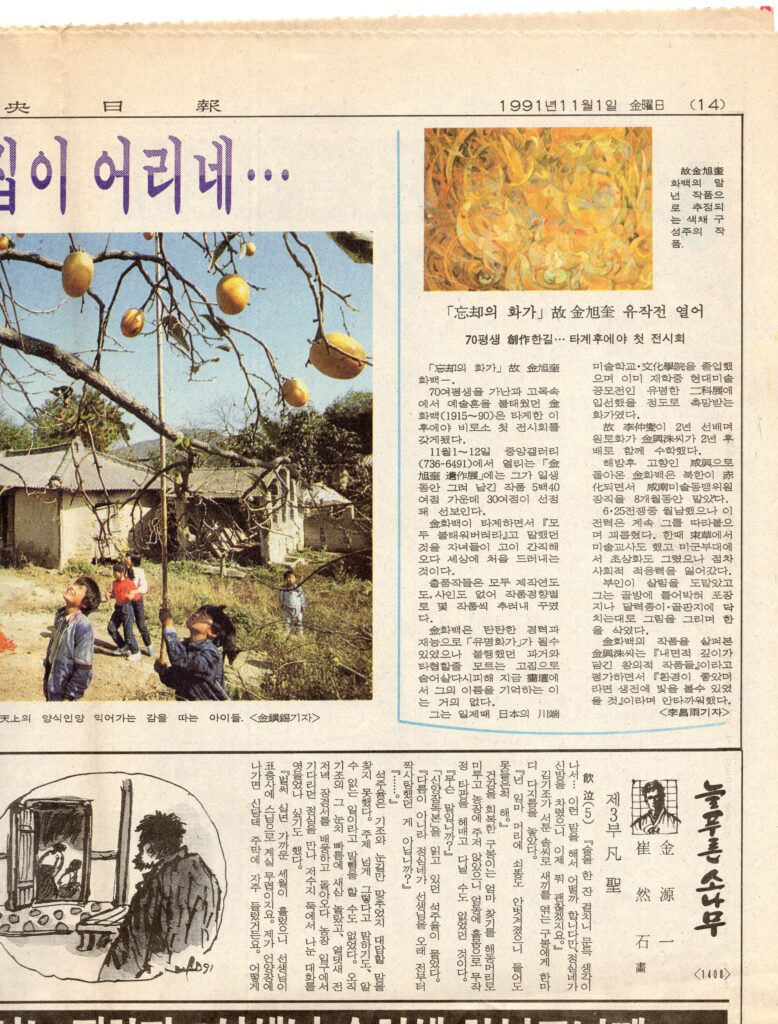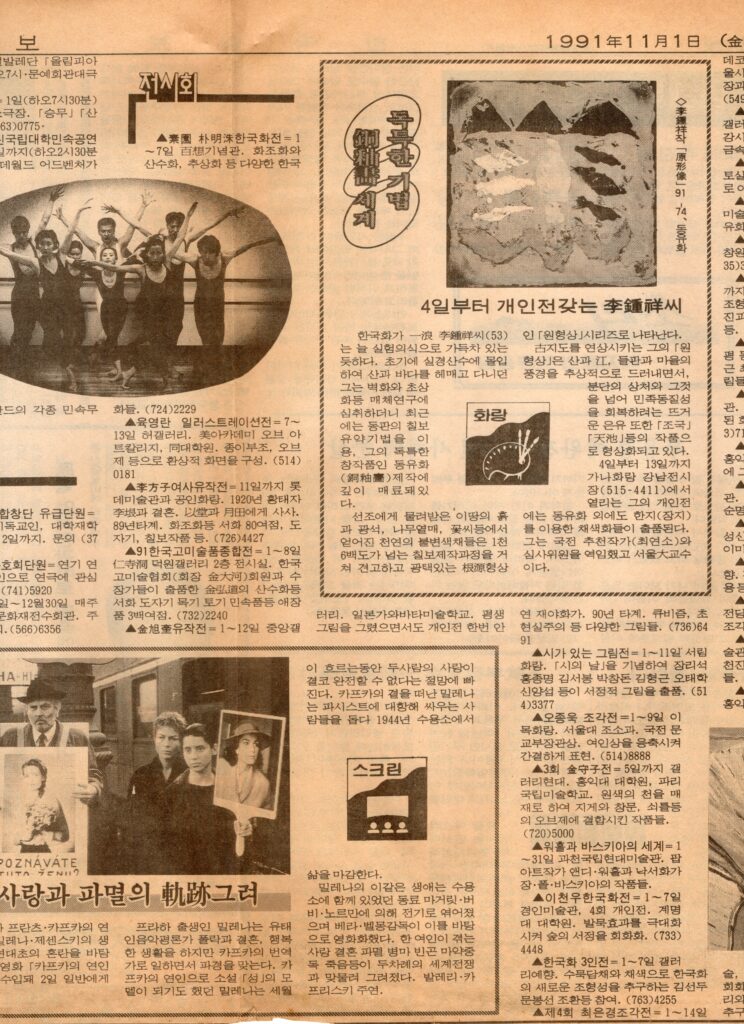
김욱규 화가 신문 자료 모음
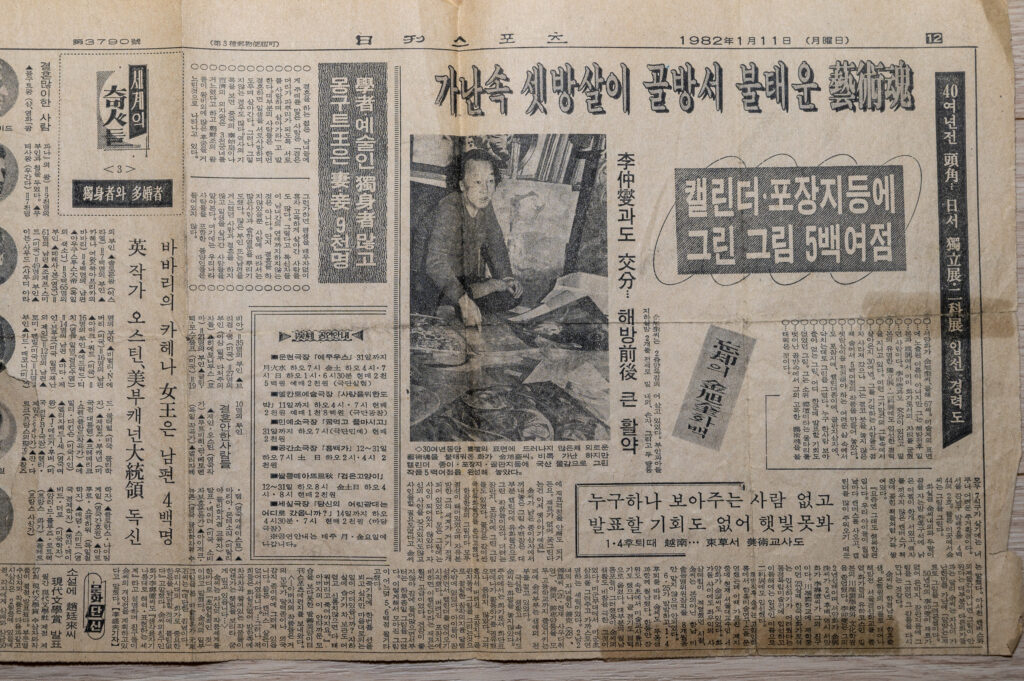
가난속 셋방살이 골방서 불태운 예술혼
김욱규화가 최초의 신문기사
가난 속 셋방살이 골방서 불태운 예술혼
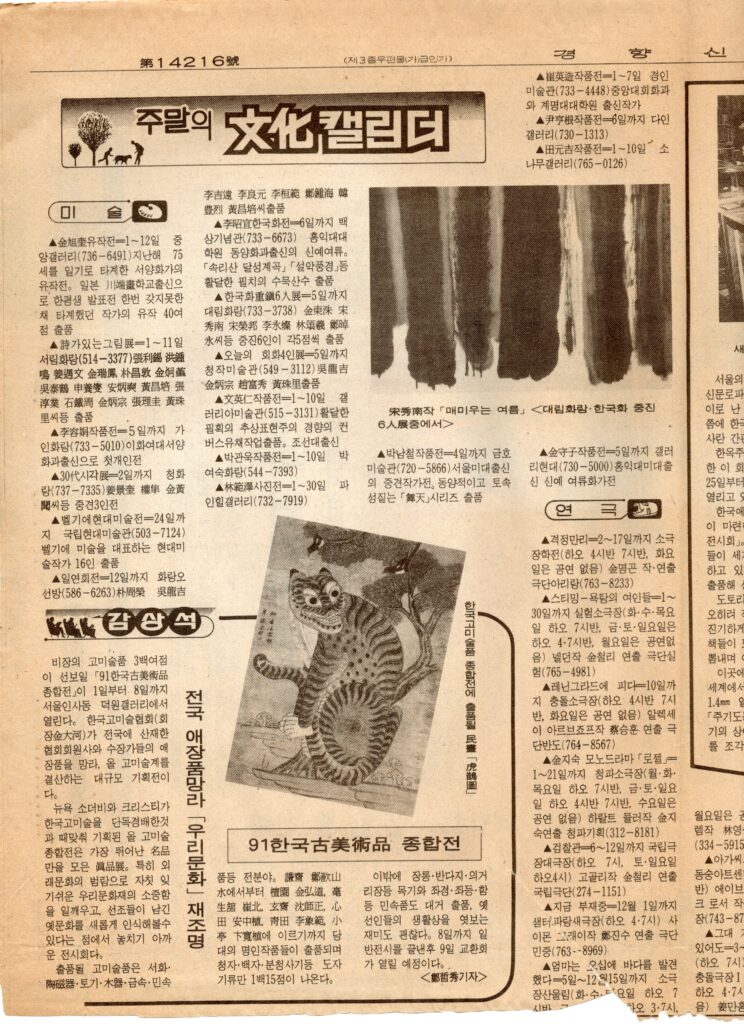
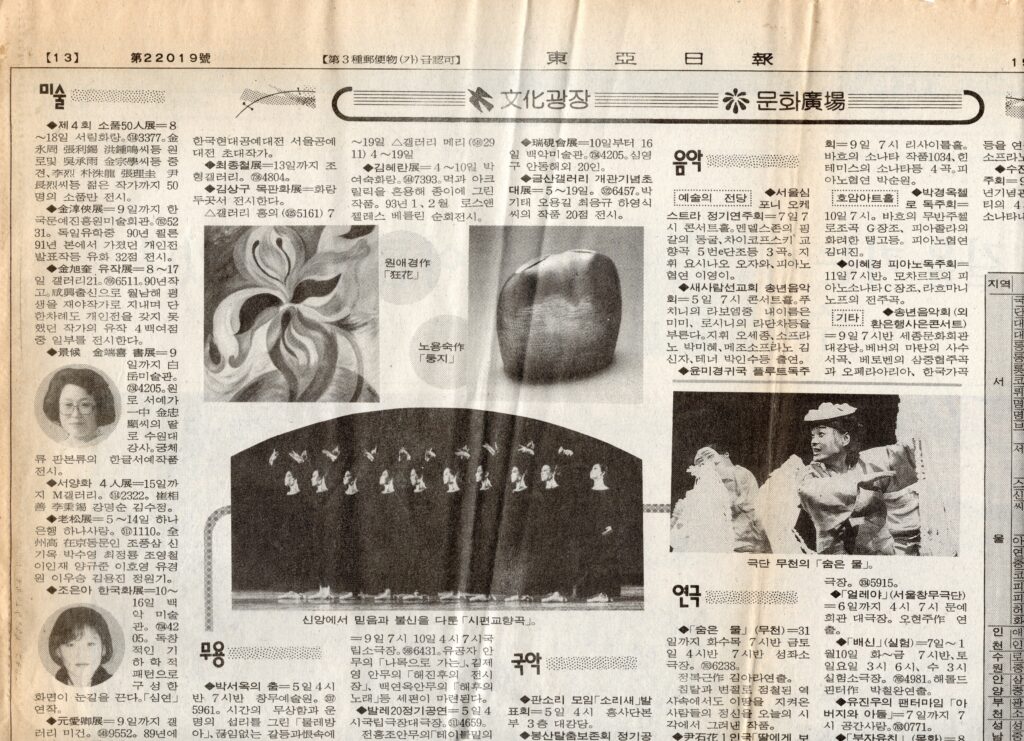
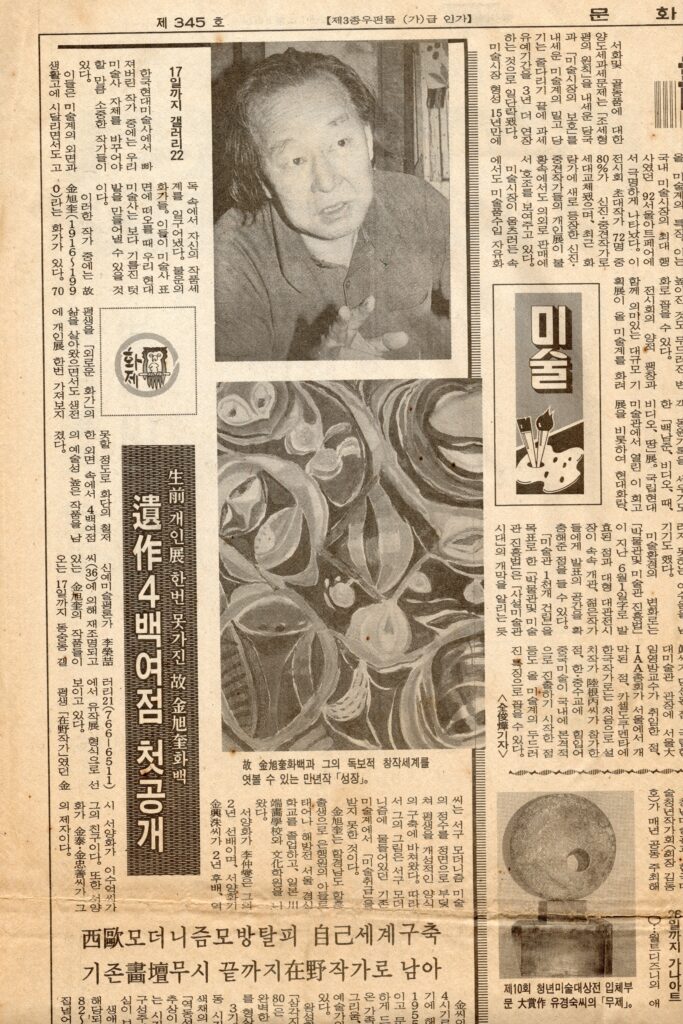
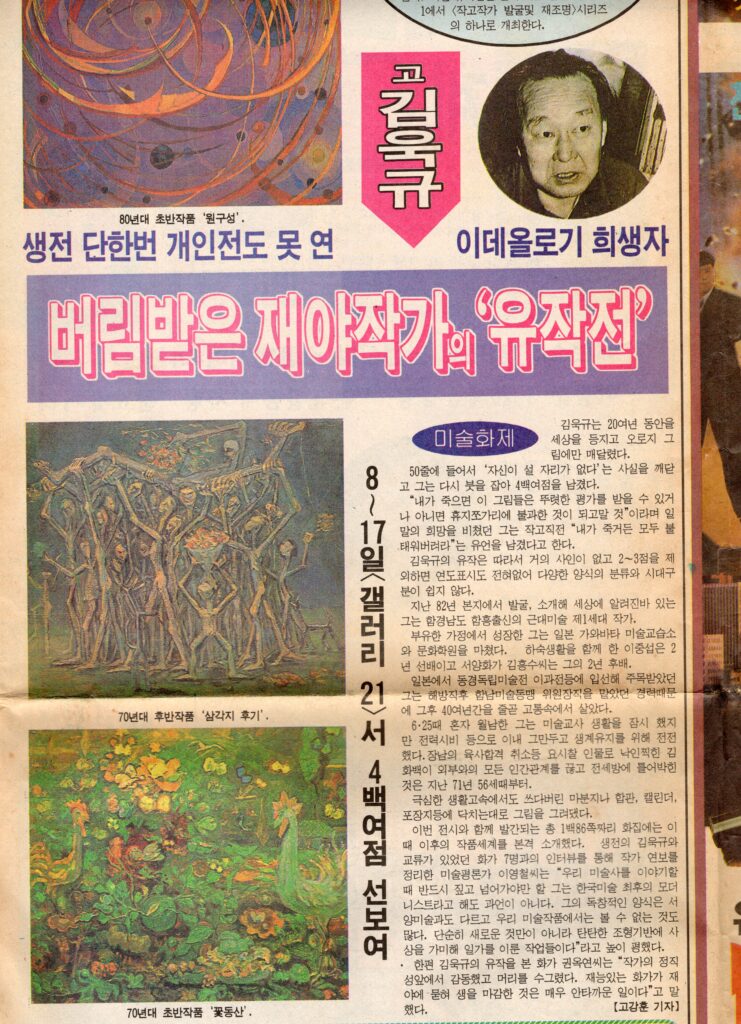
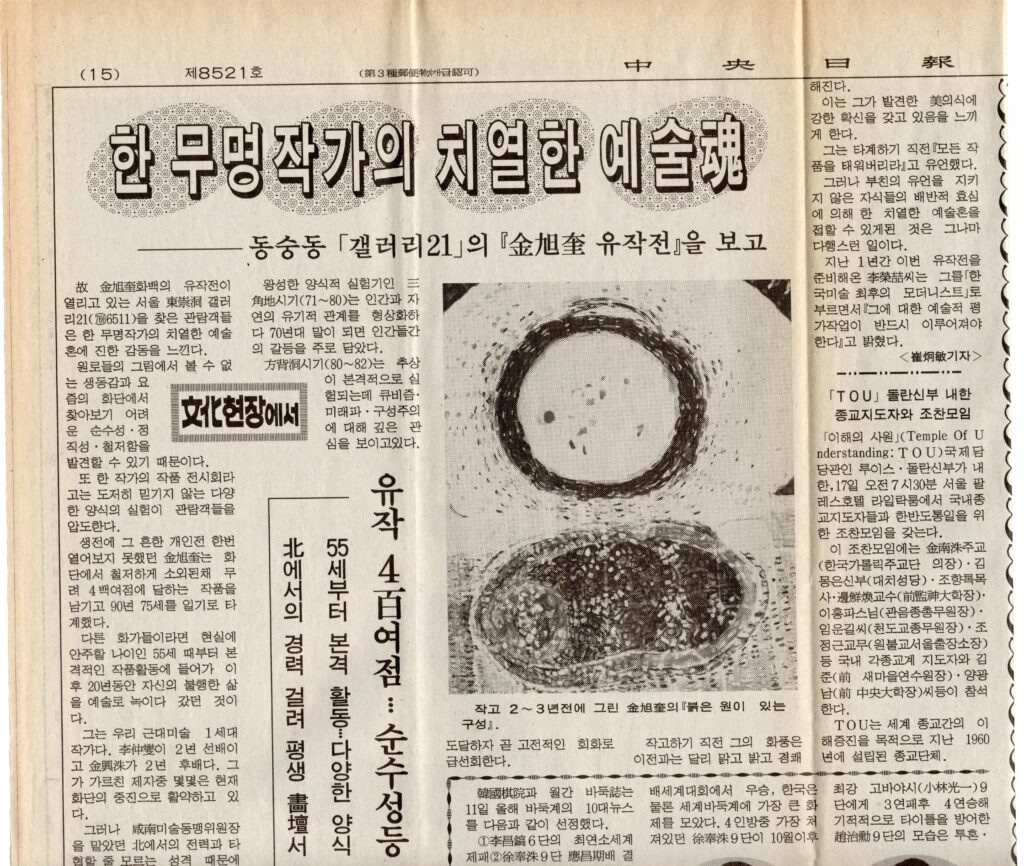
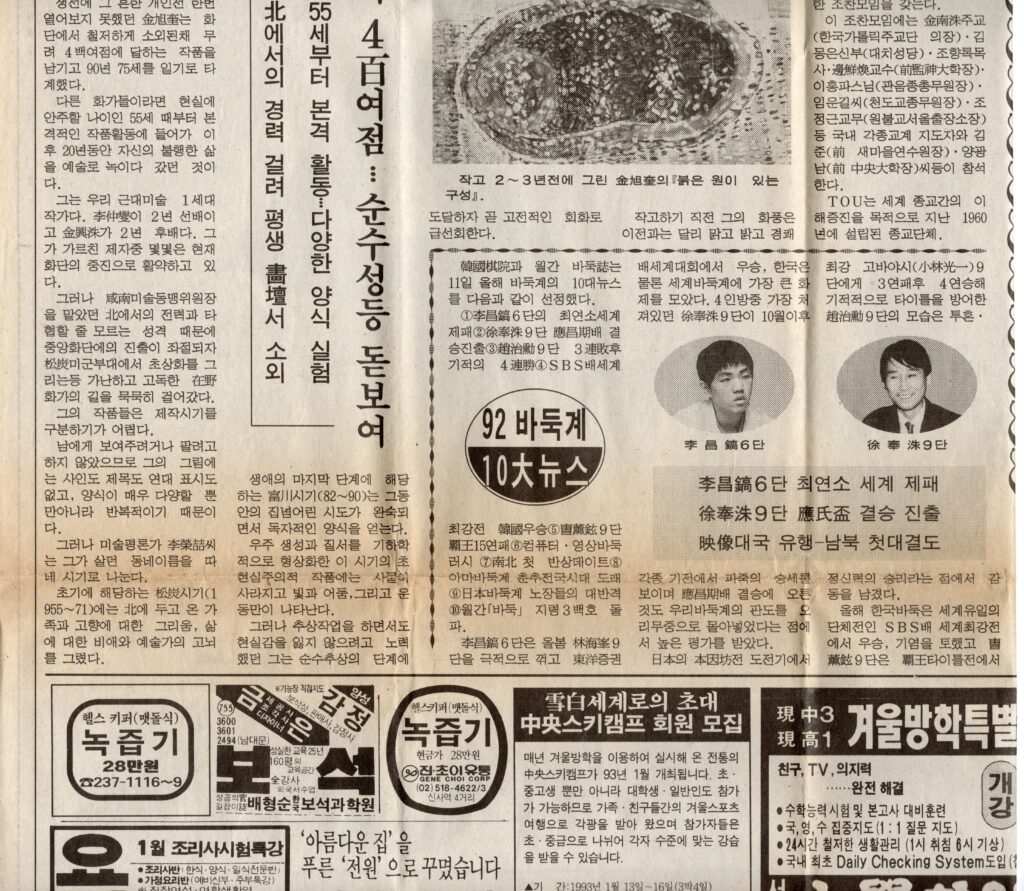
서양화가 김욱규씨, 올해 67세. 미술계의 표면에 노출된 이름이 아니지만 그는 해방전후 일본과 함흥에서 이미 화가로서의 자리를 군혔던 사람이다. 이중섭과도 교분이 있었고 일본의 유명한 독립전. 이과전에도 입선한 경력을 지니고 있다.
이런 그가 망각의 그늘속에서 살아온지 30여년. 그를 기억하는 사람들도 점차 사라져 갔으나 그는 결코 붓을 놓지 않은 채 숨어서 5백여점의 작품을 만들어 놓았다.
셋방살이를 전전해야 하는 어려운 삶 속에서도 포장지에, 캘린더 종이에, 골판지 상자에 닥치는 대로 그림을 그렸다.
누구 한사람 보아줄이 없는 그림, 어디 한군데 발표할 기회도 없었던 그림. 그는 소위 화단이라는 울타리를 벗어난 골방속에서 그의 고독한 예술혼을 불태워온 것이다.
모두 7식구가 살기에는 너무나 어려운 주거환경이다. 서울 강남구 방배2동 4백44의 2호. 물론 이곳에서 김씨는 그림을 그린다.
화실 겸 김씨 내외와 두 딸이 잠을 자는 방 한쪽 구석에 낡은 이젤이 한 개 서있고, 액자를 끼우지 않은 캔버스가 책장에 꽂힌 책들처럼 가득 쌓여있다.
“요즘엔 그래도 행복한 편입니다. 우리 아이들이 월급날마다 캔버스를 사오고, 캘린더를 많이 주워오기 때문에 재료걱정을 안 해도 되거든요. 재료가 없어 못 그린다는 건 이제 옛이야기예요.”
김씨가 낡은 종이상자에서 꺼내놓은 그림 수백장은 대부분 캘린더에 유화물감으로 그린 작품들이었다. 더러는 장판지, 포장지에 그린 그림들도 있었다. 물감은 값이 싼 국산 유화물감을 쓴다고 했다.
한 장 한 장의 그림마다 모두 정성이 배어있었으며 자유분방한 그의 세계가 거기 전개되어 있었다. 모든 그림에는 사인이 되어있지 않았다. 자신의 사인을 갖고있지도 않고 사인을 할 필요도 없다고 김씨는 말했다.
아사천 캔버스와 외제물감이 아니면 그림이 안된다는 대부분의 다른 화가들과는 달리 김씨는자신이 가난한만큼 가난에 ‘알맞는’ 재료로 그림을 그려온 셈이다.
50년대의 이중섭이 재료가 없어 은박지, 장판지 등에 그림을 그렸던 그 감동을 다시 만나는 것 같다.
김씨는 함경남도 함흥 출생. 은행원의 아들로 태어나 해방 전 서울경신학교를 졸업, 화가들의 유학코스인 일본의 가와바타 미술학교와 문화학원을 졸업했다. 이중섭은 그의 2년 선배이며, 서양화가 김흥수씨가 2년 후배, 역시 서양화가 이수억씨가 그의 친구이다. 가와바타미술학교에 재학중이던 23살 때 한국인 화가로서는 입선하기가 어려웠다는 동경독립미술전에 입선하고 이듬해에는 일본인 이름으로 이과전에도 입선했다.
해방직후 김씨는 고향인 함흥에서 함흥미술연구소를 운영했는데 이때 가르친 제자 중에 현재 서울대교수인 서양화가 김태씨도 있었다. 화가들 사이에도 좌우익의 사상대립이 격렬했던 시절, 김씨는 본의 아닌 함남 미술동맹위원장직을 8개월동안 맡지 않으면 안되었다.
6.25가 발발하고 1.4후최를 따라 김씨도 두동생과 함께 월남했다. 한동안 강원도 속초에서 미술교사를 하기도 했으나 곧 경기도 평택으로 옮겼다. 대부분의 월남 동포들이 그러했듯이 김씨의 생활도 비참을 극한 그것이었다. 미군부대에서 미군 초상화를 그려주고 가까스로 연명하는 세월이었다.
2남2녀의 자녀들이 선극, 선봉씨(현재 사우디취업), 선미, 선혜양 등을 모두 고등학교까지 졸업시키는 데에 김씨 부부는 생애의 전부를 걸고 있었다.
극심한 생활고 속에서도 김씨는 화필을 놓지 않았다. 주위에서는 화가로서 화단 표면에 나가 활동하기를 권유했으나 응하지 않았다. 그저 혼자서 버려진 포장지나 골판지 등에 그림을 그리는 것으로 절실한 창작의지를 달랠 수밖에 없었다. 버려진 포장지에 비하면 이 캘린더라는 재료는뤟씬 고급이었다. 건강이 좋지 않아 집에 들어앉으면서 부터는 하루 종일 그림을 그렸다. 이렇게 해서 모아진 금이 어느덧 5,6백점이 될 거라고 했다.
“죽기전에 한번쯤 선을 뵈고 싶지만 마음대로 되는 일이 어디있습니까? 지하실에 습기가 차 보관도 어렵고 신통치 않으면 다 태워버리고 죽어야지요.”
아버지의 이 안타까운 모습을 보다 못한 딸 선미양이 일간스포츠에 편지를 보내왔다.
<•••아버지의 작품들은 거의 모두가 달력종이나 외국 잡지 종이위에 그려져 있습니다. 물론 캔버스 살 돈이 없어서였습니다••• 그러나 저희들은 화실도 없어 방 한쪽에 차곡차곡 쌓여 있는 작품들이 언젠가는 햇빛을 보리라 굳게 믿고 있습니다•••>
김씨는 자신의 작품 세계를 한마디로 『초현실적인 것』 이라고 말했다. 김씨의 일부 그림을 본 미술평론가 원동석씨는 『대단한 집념이다. 우리시대의 화가로 중요한 한몫을 담당할 것에 틀림없다』 고 말했다. 김씨의 친구인 화가 이수억씨도 『생각을 자기 나름대로 해석.표현하는 세계』 라고 설명하며 친구들이 김씨의 개인전을 계획하고 있다고 말했다.
【이성부 李盛夫 기자】
Western-style painter Kim Uk-kyu, 67 years old this year.
He is not a name exposed on the surface of the art world, but he was a person who had already solidified his position as a painter in Japan and Hamhung around the time of Korea’s liberation. He had a friendship with Lee Jung-seob and possessed a career of being selected for Japan’s famous Independent Exhibition and Nika Exhibition.
It has been over 30 years since he lived in the shadow of oblivion like this. People who remember him have also gradually disappeared, but he never put down his brush and secretly created over 500 pieces of artwork. Even in a difficult life where he had to move from one rented room to another, he painted on anything he could get his hands on—wrapping paper, calendar paper, and corrugated cardboard boxes.
These were paintings that no single person would look at, and paintings that had no opportunity to be presented anywhere. He burned his lonely artistic soul in a small back room, completely outside the fence of the so-called art world.
It is a living environment far too difficult for a family of seven to reside in. 444-2, Bangbae 2-dong, Gangnam-gu, Seoul. Naturally, this is where Mr. Kim paints.
In one corner of the studio—which also serves as the bedroom for Mr. Kim, his wife, and their two daughters—stands a worn-out easel. Unframed canvases are stacked tightly together, looking just like books lined up on a bookshelf.
“I actually feel quite happy these days. My children buy me canvases every payday and bring home plenty of discarded calendars, so I don’t have to worry about art supplies anymore. Running out of materials and being unable to paint is a story of the past now.”
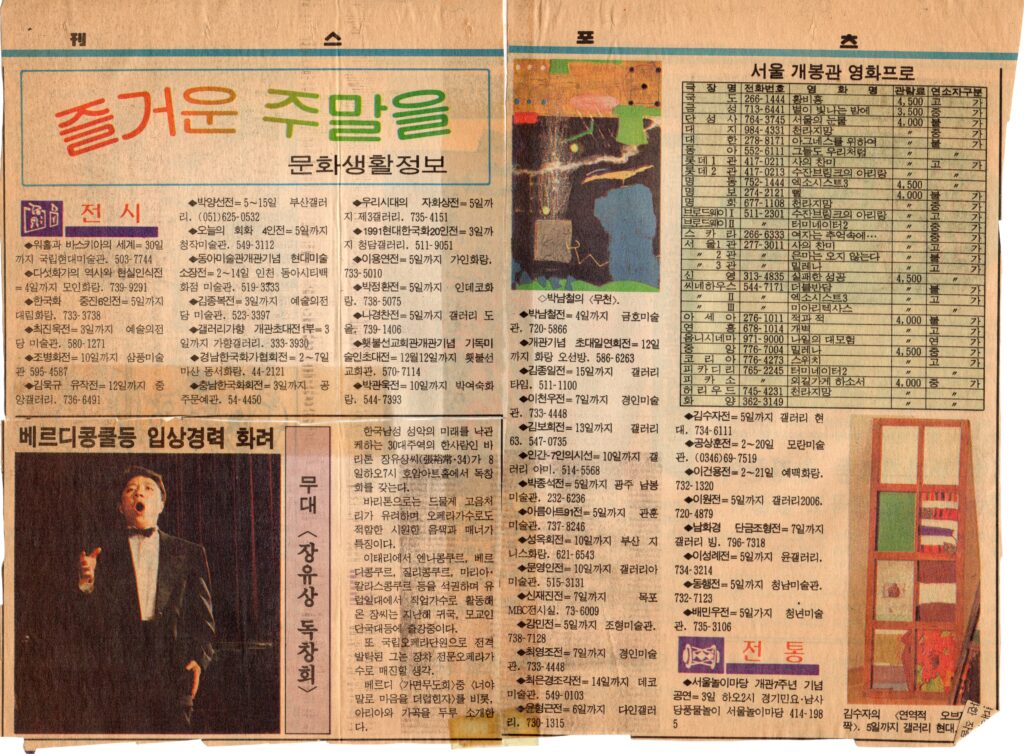
Most of the hundreds of paintings Mr. Kim pulled out from a worn-out cardboard box were oil works painted on calendars. Some were even painted on linoleum floor paper or wrapping paper. He mentioned that he uses inexpensive, domestic oil paints.Every single painting was imbued with deep devotion, revealing the free-spirited world he had unfolded there. None of the paintings bore a signature. Mr. Kim remarked that he neither had a signature of his own nor felt any need to sign them.Unlike most other painters who believe that quality work is impossible without linen canvases and imported paints, Mr. Kim has been painting with materials that are “suited” to his poverty, matching his own financial struggles.It feels like encountering once again the deeply moving spirit of Lee Jung-seob from the 1950s, who, lacking materials, drew on tinfoil and linoleum floor paper.
Mr. Kim was born in Hamhung, Hamgyongnam-do. Born as the son of a banker, he graduated from Seoul Kyungshin School before the Liberation. He later graduated from the Kawabata Painting School and the Bunka Gakuin in Japan, which were the standard study-abroad courses for painters at the time. Lee Jung-seob was his senior by two years, Western painter Kim Sou was his junior by two years, and fellow Western painter Lee Soo-euck was his close friend. At the age of 23, while attending the Kawabata Painting School, he was accepted into the Tokyo Independent Art Exhibition—a rare feat for a Korean painter. The following year, he was also accepted into the Nika Exhibition under a Japanese name.
Immediately after the Liberation, Mr. Kim ran the Hamhung Art Institute in his hometown. Among the students he taught during this time was Western painter Kim Tae, who currently serves as a professor at Seoul National University. In an era when ideological conflicts between left-wing and right-wing artists were fierce, Mr. Kim was forced against his will to serve as the chairman of the South Hamgyong Art Alliance for eight months.
When the Korean War broke out, Mr. Kim defected to the South along with his two younger brothers during the January 4 Retreat. For a time, he worked as an art teacher in Sokcho, Gangwon-do, but soon relocated to Pyeongtaek, Gyeonggi-do. Like most refugees from the North, Mr. Kim’s life was one of extreme misery. It was a time when he barely managed to survive by painting portraits for soldiers at a U.S. military base.
Mr. Kim and his wife dedicated their entire lives to ensuring that their four children—sons Seon-geuk and Seon-bong (currently working in Saudi Arabia), and daughters Seon-mi and Seon-hye—could at least graduate from high school.
Despite the severe hardships of making a living, Mr. Kim never put down his brush. Those around him urged him to step into the mainstream art scene and active display his work, but he refused. He had no choice but to soothe his intense creative desire by painting alone on discarded wrapping paper or cardboard. Compared to abandoned wrapping paper, these calendars were a far more luxurious material. Once his failing health confined him to his house, he spent the entire day painting. The collection he gathered this way had quietly grown to about 500 or 600 pieces.
“I would like to showcase them at least once before I die, but when does life ever go as planned? The basement is damp, making storage difficult. If they aren’t good enough, I should just burn them all before I pass away.”
Unable to bear the sight of her father’s heartbreaking situation any longer, his daughter Seon-mi sent a letter to the Ilgan Sports newspaper.
<…Almost all of my father’s works are painted on calendar pages or foreign magazine paper. Of course, it was because we didn’t have the money to buy canvases… However, even though we don’t even have a proper studio and the works are just stacked up tightly in a corner of the room, we firmly believe that they will see the light of day one day…>
Mr. Kim described his own artistic world in a single phrase as “surreal.” Art critic Won Dong-suk, after viewing some of Mr. Kim’s paintings, remarked, “It shows tremendous tenacity. He will undoubtedly play a significant role as an important painter of our era.” Mr. Kim’s friend, painter Lee Soo-euck, also explained it as “a world that interprets and expresses thoughts in his own unique way,” adding that friends are currently planning a solo exhibition for Mr. Kim.